
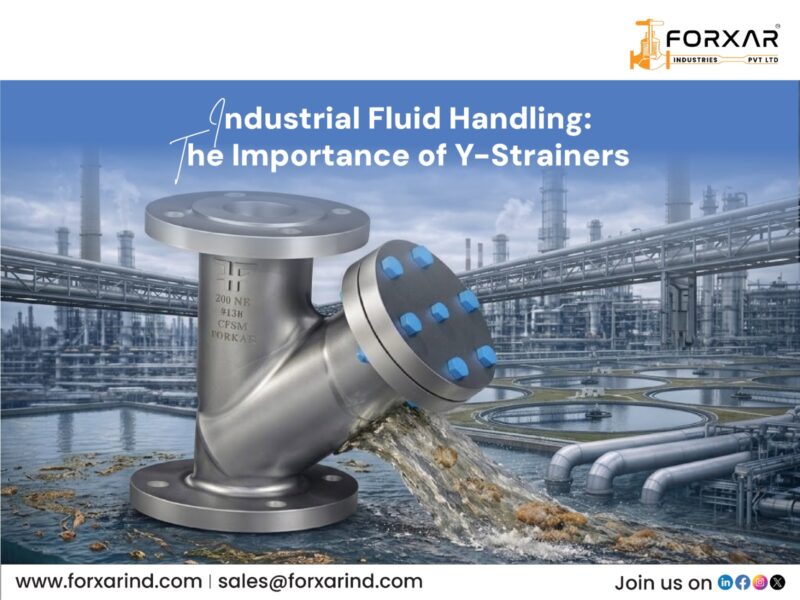
In industrial fluid handling systems, maintaining the purity and integrity of liquids and gases is critical. Contaminants such as sediments, debris, and suspended particles can damage equipment, reduce efficiency, and disrupt operations. Y-strainers play a vital role in protecting pipelines and ensuring smooth, uninterrupted flow.
This article explores the working principle, applications, types, and benefits of Y-strainers, along with key selection factors for industrial use.
What is a Y-Strainer?
A Y-strainer is a mechanical device installed in pipelines to filter out unwanted solid particles from liquids, steam, or gases. It uses a wire mesh or perforated screen to trap debris while allowing clean fluid to pass through.
Y-strainer are widely used because they are:
- Compact in design
- Easy to install
- Cost-effective
- Efficient in protecting downstream equipment
Why Are Y-Strainers Important?
Industrial pipelines often carry fluids that contain:
- Dirt and rust particles
- Sediments and debris
- Semi-solid contaminants
Without proper filtration, these impurities can:
- Block valves
- Damage pumps and regulators
- Reduce system efficiency
- Increase maintenance costs
Y-strainer act as the first line of defense, ensuring system reliability and longevity.
Working Principle of Y-Strainers
The Y-strainer gets its name from its Y-shaped body design.
How it works:
- Fluid enters the strainer.
- The mesh screen captures particles larger than its openings.
- Clean fluid exits the system.
- Collected debris can be removed through cleaning or maintenance.
This design allows smooth flow with minimal pressure drop, making it ideal for continuous industrial operations.
Common Applications of Y-Strainers
Y-strainer are used across multiple industries, including:
- Steam pipeline systems
- Industrial heat exchangers
- Air and natural gas lines
- Power plants (condensers and turbines)
- Chemical and petrochemical industries
Their versatility makes them suitable for both liquid and gas filtration applications.
Types of Y-Strainer End Connections
Choosing the right connection type is essential for system compatibility:
1. Flanged Y-Strainers
- Suitable for high-pressure systems
- Comply with ANSI standards
- Provide leak-proof sealing using gaskets
2. Welded Y-Strainers
- Ideal for high-temperature and high-pressure environments
- Permanent and highly durable connections
3. Threaded Y-Strainers
- Easy to install and cost-effective
- Best for residential and low-pressure commercial systems
Key Factors to Consider When Selecting a Y-Strainer
To ensure optimal performance, consider the following:
Fluid Type
Determine whether the application involves liquid, gas, or steam to select compatible materials.
Pressure Rating
Ensure the strainer can handle the system’s maximum pressure.
Mesh Size
- Fine mesh captures smaller particles
- Coarse mesh allows higher flow rates
Connection Type
Match the strainer connection with your pipeline system.
Maintenance Requirements
Choose designs that allow easy cleaning and replacement.
Benefits of Using Y-Strainers
- Protects expensive equipment
- Improves system efficiency
- Reduces downtime and maintenance costs
- Extends pipeline lifespan
- Ensures consistent fluid quality
Forxar Industries: Trusted Y-Strainer Manufacturer in India
Forxar Industries is a leading manufacturer of high-quality Y-strainers in India. Known for their durability, performance, and innovation, they provide a wide range of filtration solutions tailored to various industrial needs.
Their products are designed to meet stringent industry standards, ensuring reliability and long-term performance.
Conclusion
Y-strainers are small yet essential components in industrial filtration systems. They help maintain fluid purity, protect equipment, and ensure efficient operations. By selecting the right Y-strainer based on your application, you can significantly improve system performance and longevity.
For reliable and high-performance solutions, partnering with trusted manufacturers like Forxar Industries is a smart investment.