
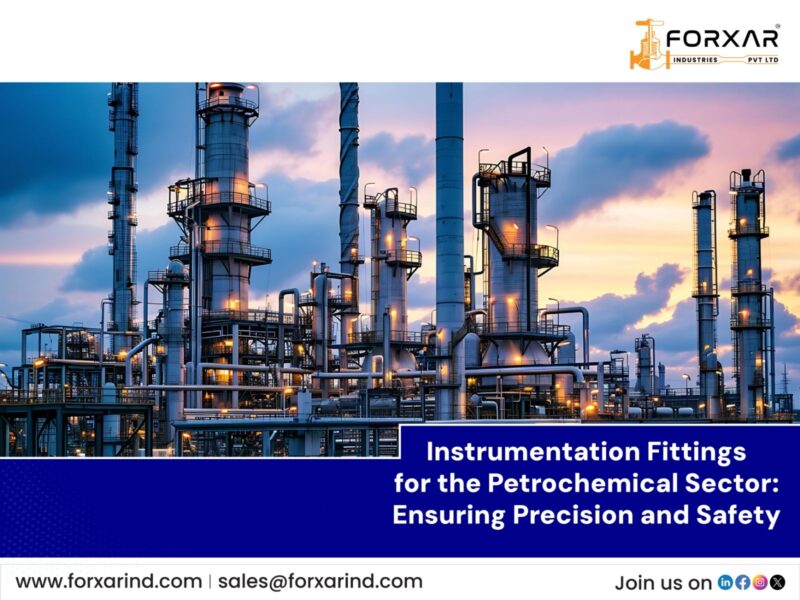
The Petrochemical Industry is the backbone of modern Industrial Development, transforming raw Hydrocarbons into a wide range of essential products, from Plastics to Fertilizers. Because of the complex and high-risk nature of petrochemical operations, Precision, Safety, and Reliability are critical at every stage of the process. One of the most important yet often overlooked components supporting these operations is Instrumentation Fitting.
Instrumentation Fitting in petrochemical industry play a vital role in controlling and monitoring key process parameters such as Pressure, Temperature, and Flow. Without reliable fittings, even the most advanced instrumentation systems cannot function accurately or safely.
The Role of Instrumentation Fittings in Petrochemical Plants
Instrumentation Fittings are designed to Connect, Seal, and Guide fluid or gas lines within measurement and control systems. These fitting ensure that signals from instruments remain accurate and that process media are safely contained within the system.
In Petrochemical Plants and Refineries, operating conditions often include:
- Extreme Temperatures
- High Pressures
- Corrosive Chemicals
- Continuous Process Cycles
Under such demanding environments, fitting must provide leak-proof performance and structural integrity. Even a minor leak or inaccurate reading can result in safety hazards, production losses, environmental risks, and costly downtime.
Types of Instrumentation Fittings Used in the Petrochemical Industry
Different applications require different types of fitting. Selecting the right fitting depends on pressure rating, temperature range, fluid characteristics, and maintenance requirements.
1. Tube Fittings
Tube fittings are widely used in high-pressure instrumentation systems. They provide strong, leak-tight connections and are typically manufactured from stainless steel or corrosion-resistant alloys. Their durability makes them ideal for hostile industrial environments.
2. Pipe Fittings
Pipe fittings connect pipes of varying sizes and configurations. Common examples include Elbows, Tees, Reducers, and Unions. In petrochemical facilities, these fittings must resist corrosion and mechanical stress while maintaining reliable flow control.
3. Compression Fittings
Compression fitting are commonly used in systems that require periodic maintenance or reassembly. They create a tight seal without welding, allowing for easy installation and secure connections. This makes them highly suitable for petrochemical maintenance operations.
4. Instrumentation Valves and Manifolds
Instrumentation valves such as Ball Valves and Needle Valves regulate fluid and gas flow. Manifolds allow multiple instruments to connect to a single pressure source, reducing potential leak points and simplifying system design.
5. Quick Connect Fittings
Quick Connect fittings are ideal for applications requiring frequent connection and disconnection, such as calibration and testing. They offer speed, convenience, and secure sealing without the need for specialized tools.
Material Selection: Critical for Performance and Longevity
Material selection is a key factor in ensuring long-term reliability. Petrochemical processes often involve highly corrosive substances, making material performance crucial.
Common materials include:
- Stainless Steel – Strong, versatile, and resistant to corrosion
- Hastelloy – Suitable for highly corrosive chemical environments
- Inconel – Performs well at high temperatures and pressures
- Monel – Excellent resistance to specific aggressive chemicals
Choosing the appropriate material extends service life, reduces maintenance costs, and enhances operational safety.
Quality and Certification: A Non-Negotiable Requirement
In the petrochemical sector, quality is paramount. Poor-quality fittings can lead to leaks, equipment failure, environmental damage, and severe safety incidents.
Reputable manufacturers ensure compliance with international standards such as:
- ISO 9001
- ASTM
- NACE
- MSS
- API
Additionally, fittings undergo strict quality testing, including pressure testing, corrosion resistance testing, dimensional inspection, and material traceability checks. These measures ensure consistent and reliable performance in critical applications.
Conclusion
Instrumentation Fittings may be small components, but they are essential to the Safety, Reliability, and Efficiency of Petrochemical Operations. Proper selection, high-quality materials, and adherence to industry standards ensure that process systems operate with precision and confidence.
Forxar Industries Pvt Ltd is committed to delivering high-performance Instrumentation Fittings designed to meet the demanding requirements of the Petrochemical Industry. With a strong focus on Quality, Innovation, and Customer Satisfaction, we provide solutions that help ensure operational safety and long-term reliability.